



Understanding E-Signatures
Electronic signatures are transforming how businesses operate, providing a fast, secure, and legally binding method to sign documents without the constraints of paper or geography. In this chapter, we’ll go into detail about what e-signatures are, explore their legal standing across jurisdictions, and highlight their key benefits.
What are e-signature platforms?
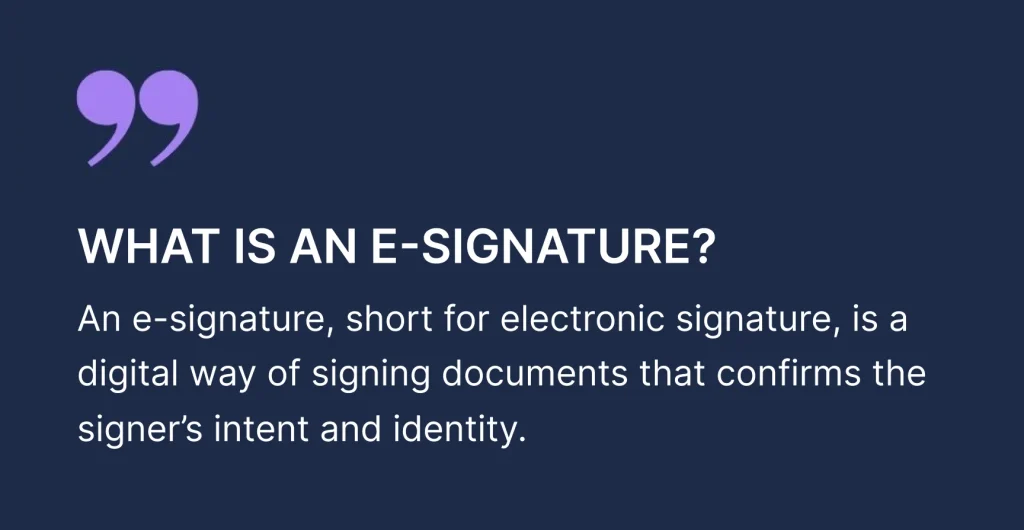
An e-signature is a digital way of signing documents that confirms the signer’s intent and identity. Think of it as a modern replacement for a handwritten signature that captures the same information more quickly, safely, and flexibly.
In its simplest form, an e-signature signifies an electronic agreement. This can range from typing your name, using a stylized digital signature, clicking an “I agree” button, or drawing your signature via a touchpad. The variety of e-signatures available ensures adaptability across industries, document types, and workflows.
Types of e-signatures
There are three main types of e-signatures, each offering varying levels of security and sophistication:
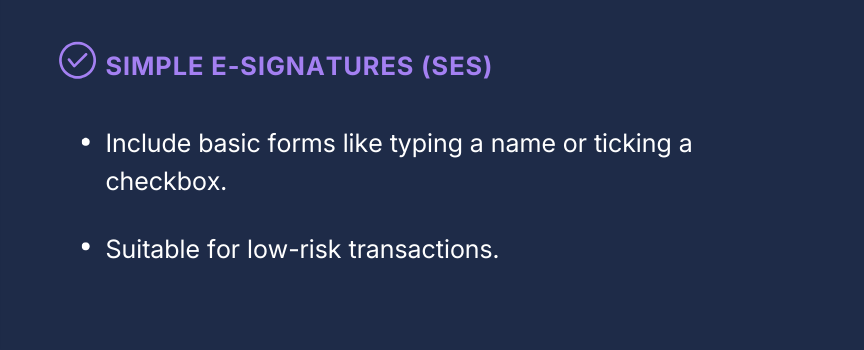
Simple e-signatures (SES):
These include basic forms like typing a name or ticking a checkbox. They’re suitable for low-risk transactions that don’t have heavy legal implications, such as internal approvals or basic agreements.
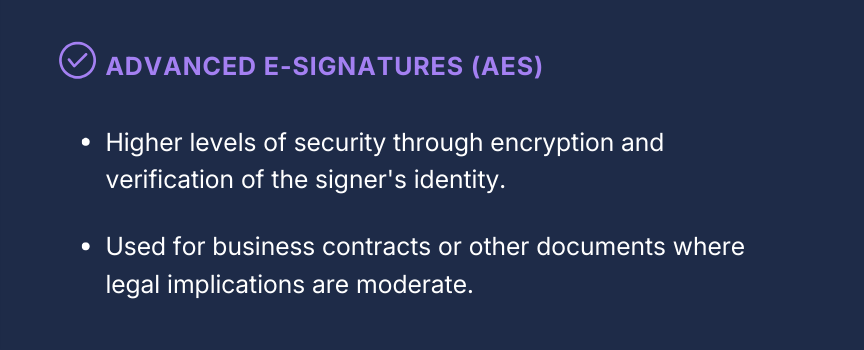
Advanced e-signatures (AES):
These offer higher levels of security by incorporating encryption and verification of the signer’s identity. Typically used for business contracts or other documents where legal implications are moderate, AES ensures both authenticity and tamper resistance.
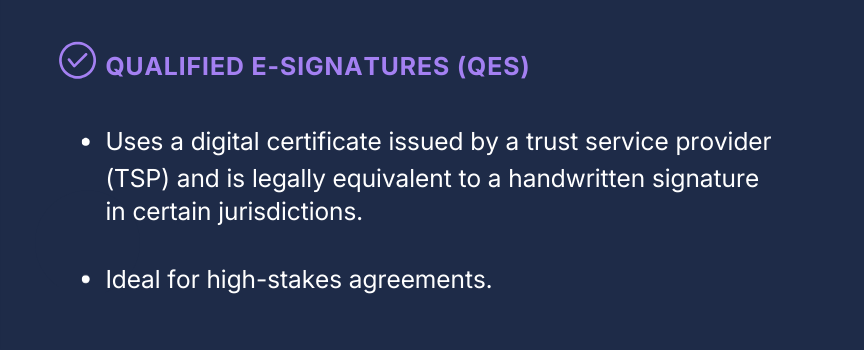
Qualified e-signatures (QES):
The most secure type, a QES uses a digital certificate issued by a trust service provider (TSP) and is legally equivalent to a handwritten signature in certain jurisdictions. It’s ideal for high-stakes agreements, such as property sales or financial documents, and validation may be in the form of in-person verification or video verification.
Legal standing and global regulations
E-signatures are widely recognized and regulated under global frameworks to ensure their usability and enforceability. Understanding the laws governing e-signatures in your region is crucial to selecting a platform that complies with industry standards and provides local authorization.
United States:
Under the E-Sign Act and UETA, e-signatures have the same legal standing as handwritten signatures if all conditions of consent, authenticity, and intent are met. A lengthy list of documents can’t be signed this way, though, from adoption papers to trusts and wills.
European Union:
The eIDAS regulation establishes clear standards for e-signatures across EU member states, emphasizing the use of AES and QES for high-security use cases. BoldSign maintains an EU data center to maintain compliance.
Other regions:
Countries like Australia, Canada, (where we have a dedicated data center), and India also have specific laws enabling the use of e-signatures. For businesses operating internationally, partnering with a platform that adheres to multiple regulatory standards ensures legal compliance without added complexity.
Regardless of jurisdiction, e-signatures must meet three critical criteria to be legally binding:
- Intent: The signer must intend to sign the document.
- Consent: Both parties must agree to conduct business electronically.
- Verification: The signature should be tied to the unique identity of the signer and secure against tampering.
The benefits of using e-signatures
Transitioning to e-signatures is more than just a technical upgrade. It represents a major shift in how organizations operate, saving time, cutting costs, and contributing to sustainable practices. Here are the core benefits that make e-signatures essential for businesses today:
Enhanced productivity and efficiency
Time is one of the most critical resources in any organization, and e-signatures streamline processes to reduce or eliminate unnecessary lag. Traditional methods of printing, signing, scanning, and mailing documents are often slow and prone to bottlenecks. By implementing e-signatures, your team can handle approvals, contracts, and agreements faster with:
- Instant document access: Instead of tracking physical versions, e-signatures allow immediate access to digital documents from anywhere in the world.
- Fewer errors: Digital workflows minimize missed fields, incomplete signatures, and back-and-forth communication to fix mistakes.
- Automated workflows: Platforms often enable automated reminders, document progress tracking, and integration into project management tools, reducing manual effort.
- Improved team management: E-signature platforms offer centralized dashboards for document collaboration and tracking, making it easy for managers to assign tasks and monitor document progress.
- Custom branding: You can personalize emails, documents, and signing interfaces with your logo, colors, and branding to maintain consistency and professionalism across client interactions.
- Request signatures via SMS and WhatsApp: Sending e-signature requests via SMS can offer faster reach and response from recipients, giving them the ability to view and sign documents directly from their smartphone or tablet, or using familiar platforms like WhatsApp, minimizing delays.
Cost savings
Switching to e-signatures eliminates many of the costs associated with paper-based workflows, especially when scaled across an organization. Consider the full range of expenses from paper and ink to couriers, storage, and administrative time. With e-signatures, the savings compound in multiple areas:
- No printing or shipping: Reduce the operational costs of buying supplies and sending documents via couriers or postal services.
- Smaller administrative burden: Time spent on scanning and filing documents can be redirected toward more strategic work.
- Fewer errors to correct: Since e-signature platforms reduce the likelihood of missing data or signatures, organizations save on reprocessing time and effort.
Environmental benefits
Paper-based signatures contribute to deforestation, energy consumption during printing, and waste generation. By switching to e-signatures, your company can take a significant step toward reducing its environmental impact while also setting a positive example for employees, clients, and stakeholders.
Key environmental advantages include:
- Paper and ink reduction: Say farewell to bulky print jobs for contracts that could easily live in an electronic format.
- Lower carbon footprint: By eliminating the need for physical delivery, businesses contribute to fewer transportation-related emissions.
- Digital archiving: Free up physical storage space and reduce waste by storing documents securely in electronic vaults.
Understanding e-signatures is the first step to choosing the right platform for your needs. By simplifying and improving how documents are signed, e-signatures deliver practical solutions to modern business constraints while driving productivity, savings, and sustainability.
In later chapters, we’ll explore how to evaluate platforms based on key criteria like security, compliance, and scalability. For organizations ready to reap the benefits of e-signatures, the next step is selecting a solution that aligns with your goals and ensures trust among all users and stakeholders.
What comes next in the e-signature guide?
Chapter 3, Essential Features of E-Signature Platforms, covers ease of use, speed, automation, security, and compliance. Or download all eight chapters as one PDF.
Understanding E-Signatures: common questions
What are the three types of electronic signatures?
The EU eIDAS regulation defines simple (SES), advanced (AES), and qualified (QES) electronic signatures. Each level adds stronger signer identity checks. BoldSign supports qualified electronic signatures.
Are electronic signatures legally binding?
Signatures you collect with BoldSign are legally binding under the ESIGN Act, UETA, and eIDAS. See e-signature legality by country for other regions.
Last updated: October 19, 2026