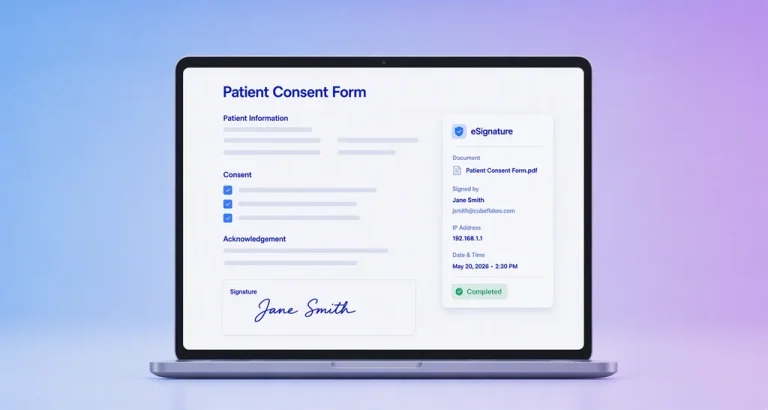
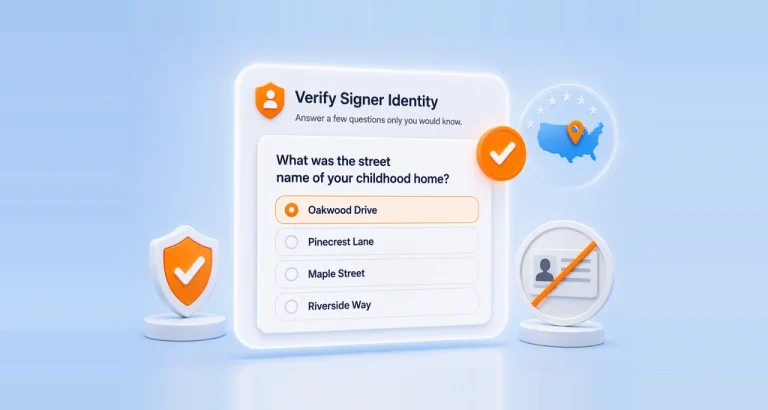
TL;DR: Building an in-house eSignature engine and buying an embedded eSignature API are not equally risky choices. Building means owning audit trails, identity verification, storage, security, and support for as long as the product exists. Buying usually gets a team to production faster and shifts much of the underlying signing infrastructure burden to the vendor, though you still own your integration, processes, configuration, and applicable compliance responsibilities. The right call depends on whether signing is core to what you sell.
Every product team eventually faces the same decision: build the signing capability, or embed it from a vendor. Either way, the team needs a signing workflow reliable enough to hold up operationally and legally, not just a signature box.
Building looks appealing at first: full ownership, no dependency on someone else’s uptime, and no outside invoice. Then someone asks who owns the audit trail six months after launch, and the room gets quieter. That question comes down to ownership versus speed.
This guide covers what building actually costs beyond development hours, what the law requires either way, and how to evaluate an eSignature API if buying is the better fit. For the broader case on why most teams buy, see BoldSign’s build vs buy eSignature guide. The rest of this guide focuses on the API decision.
What build and buy mean for an eSignature API
For product teams, the decision comes down to two paths: build your own signing engine, or embed a vendor’s eSignature API. Each puts a different amount of work, and control, in your hands.
Building in-house. You take on document preparation, signature placement, signer permissions, identity verification, audit logging, consent capture, storage, notifications, status tracking, security, and maintenance. In practice, this means building a signature platform, not a signing box.
Buying an embedded API. An embedded API gives developers control without building signature infrastructure from scratch. Teams get REST API access, documentation with sample code, embedded signing, webhook events, reusable templates, and identity verification, while your application remains the experience signers see.
What you own if you build an eSignature engine
This is where teams underestimate scope. Building is not a signing page. It is a chain of responsibilities your team owns for the life of the product.
- Signature workflow logic. Sending, review, reminders, completion, and every failure a signer can hit, not just the happy path.
- Audit trail. A record of who did what, when, and in what context. A weak trail undermines your evidence in a dispute.
- Identity verification. Choosing between email access, OTP, SMS, or stronger checks, since different workflows carry different levels of risk.
- Consent and intent capture. The ESIGN Act makes electronic signatures broadly valid, but enforceability depends on your own consent and recordkeeping process.
- Document integrity. A defensible way to preserve signed documents and detect tampering after signing.
- Webhook reliability. Delivery, retries, and failure monitoring become your job once any part of your product depends on real-time status.
- Storage and retention. Where documents live, for how long, who can access them, and how they are deleted or exported.
- Templates and repeatability. Without reusable templates, senders recreate slightly different versions of the same agreement as volume grows.
- Security and uptime. Encryption, access controls, monitoring, and incident response become your responsibility, and the stakes are real: IBM’s 2026 report puts the global average cost of a data breach at $4.99 million.
- Developer support burden. Every edge case and signing dispute comes back to your own team, not a vendor’s support desk.
None of this is a reason to avoid building. It is a reason to start with an accurate picture of what building involves.
When building in-house can make sense
Building can be the right call when eSignature is core to what you sell, your workflow needs are unusual, or your team already has the capacity to support it long term. These cases are less common than most teams assume. If signing does not differentiate your product, buying is usually the more defensible choice.
The hidden cost of building
The most common mistake in a build vs buy discussion is comparing a vendor’s price to a rough development estimate. What matters is total cost of ownership across at least two years, not the sprint it takes to ship a prototype.
Cost categories that rarely make the first estimate include developer hours, QA, security and legal review, infrastructure, incident response, support, and the time taken away from your product roadmap.
| Cost area | Build in-house | Buy an embedded API |
| Initial engineering | High | Medium |
| Time to launch | Slow | Fast to moderate |
| Embedded UX control | High | High |
| Compliance ownership | High | Shared |
| Maintenance burden | High | Low to medium |
| Support load | High | Medium |
| Custom workflow flexibility | Highest | High |
| Implementation risk | High | Medium to low |
Legal and compliance realities
In the United States, the ESIGN Act establishes that a signature cannot be denied legal effect solely because it is electronic. The EU’s eIDAS Regulation does the same across tiers of assurance. Neither removes the need for signer intent, consent, and accurate recordkeeping, and regulated industries add requirements on top, such as 21 CFR Part 11 for FDA-regulated activities.
BoldSign’s broader guide covers this legal ground in depth. The API-specific question is narrower: which compliance mechanics does a vendor handle for you, and which do you still own regardless of which vendor you choose?
What buying an eSignature API gives you
A mature eSignature API removes much of the infrastructure work that delays launch. Teams get embedded signing, reusable templates, webhook events, status tracking, sample code, sandbox testing, and identity checks without owning the underlying platform.
Identity checks come in two forms:
- Signer authentication: an access code or SMS passcode that confirms who opened the signing link.
- Identity verification: a government ID plus a selfie for higher-stakes agreements.
NIST’s Digital Identity Guidelines provide broader guidance on identity proofing and authentication assurance levels. Buying an API lets you choose the right level for each workflow instead of building both yourself.
Build vs buy decision matrix
Here is the side-by-side comparison most teams need:
| Decision factor | Build | Buy an embedded API |
| Launch speed | Slowest | Fast |
| In-product experience | Full control | Strong |
| Engineering ownership | Highest | Moderate |
| Compliance burden | Highest | Shared |
| Audit trail responsibility | You own it | Vendor-led, with integration responsibility |
| Workflow automation | Custom, heavy lift | Strong, via API and webhooks |
| Reusable templates | Must build | Usually included |
| Webhook events | Must build | Common feature |
| Branding control | High | High |
| Long-term maintenance | Highest | Lower |
For most embedded use cases, buying an eSignature API is the practical middle ground: you keep control of the signer experience without owning the signing infrastructure.
How to evaluate an eSignature API vendor
Do not stop at the price per document. Review the API documentation, sample code, and getting-started flow, and confirm that a free sandbox is available so you can test before committing.
Check whether the vendor maintains SDKs for your languages, such as .NET, Java, Node.js, PHP, or Python, and supports API key or OAuth authentication. A maintained SDK can simplify authentication, request handling, and error handling across supported programming languages. A Postman collection or interactive API explorer also shortens testing and implementation time.
Webhook reliability is one of the hardest things to get right on your own. Look for documented retry behavior and clear failure handling, so a completed signature never silently fails to reach your system.
Finally, look for transparent pricing and a clear migration path. Vendors that publish API pricing openly make it easier to estimate costs before implementation.
Questions to ask any vendor:
- How quickly can we start testing in a sandbox?
- How are webhook retries and failures handled?
- Does the signer ever leave our app?
- What authentication and identity verification options are available?
- How difficult is migration if our requirements change later?
A practical eSignature API example with BoldSign
Consider a SaaS platform that manages customer onboarding for financial services. Signers need to review and sign documents inside the product, and account setup should start as soon as signing is complete. Building this in-house means creating the signing interface, tracking the document lifecycle, storing evidence, and wiring event delivery into your own systems.
With BoldSign’s eSignature API, the team creates a reusable template, sends it with one call, embeds signing in the app, and listens for a webhook when signing is complete. It retries failed webhook deliveries six times using an exponential backoff schedule, then monitors the webhook’s health for seven days before it may be disabled, so a completed signature is unlikely to go unnoticed. Sending from a saved template can be a single request:
curl -X POST 'https://api.boldsign.com/v1/template/send?templateId={template_id}' \
  -H 'accept: application/json' \
  -H 'X-API-KEY: {api_key}' \
  -H 'Content-Type: application/json' \
  -d '{
    "roles": [
      {
        "roleIndex": 1,
        "signerName": "David",
        "signerEmail": "[email protected]"
      }
    ]
  }'
The send call is one piece. Embedding the signing view requires a second call plus front-end code to render it, and status tracking requires a webhook endpoint on your side to receive events. Developers build these three pieces once, then reuse the same pattern for every new customer.
Because a setup like this usually serves many customers, the API lets each customer have its own white-labeled signing experience, with its own logo and colors on the signing page, without maintaining separate template libraries in code.
Estimate your own cost of building vs buying
Every team’s numbers are different, so a generic estimate won’t tell you much. Instead, add up these costs for each option over the same period, ideally two years, since maintenance and support keep running long after launch:
Total cost = engineering time + ongoing maintenance and support + infrastructure + security and legal review + vendor fees
| Cost input | Build in-house | Buy an embedded API |
| Engineering time | Full signing engine: workflow logic, audit trail, identity checks, webhooks, storage | Integration only: send calls, embedded signing view, webhook listener |
| Ongoing maintenance and support | Grows with volume, edge cases, and signing disputes | Limited to your integration |
| Infrastructure | Hosting, storage, monitoring, and backups | Included by the vendor |
| Security and legal review | Full review of the signing platform | Vendor review plus your integration |
| Vendor fees | None | BoldSign Enterprise API: starts at $30/month, including 40 signature requests; $0.75 per additional signature request |
To estimate engineering time and maintenance in dollars, multiply the hours by your fully loaded hourly developer cost.
Most teams that run this exercise find the build column keeps growing after launch, while the buy column stays mostly predictable. To skip the manual math on the buy side, use BoldSign’s eSignature ROI calculator.
Common objections to buying
What about vendor lock-in? A fair concern, but building creates lock-in too: to your own maintenance burden, instead of a vendor relationship you can renegotiate or leave.
Will we lose branding control? Not with an embedded API. Your application stays the primary interface, and white-labeling options let signing pages carry your logo and colors.
Is our workflow too custom? Sometimes, but many teams assume they need custom infrastructure when templates, API calls, and webhooks cover most requirements.
Isn’t buying more expensive? Per document, sometimes. Once maintenance, support, and compliance review are included, buying is often cheaper than owning the full platform.
Questions to ask before deciding
Before you commit, get honest answers to these questions:
- Is signing core to our competitive advantage, or a workflow we simply need to support?
- How fast do we need to launch?
- Who owns support after go-live?
- How regulated is this workflow?
- What does the two-year cost look like with maintenance and compliance review included?
Recommended path by company type
Startups usually buy an API, since launch speed matters more than owning signature infrastructure at an early stage.
SaaS platforms typically buy as well, unless signing is core IP, since embedded signing and webhook automation matter more than full ownership.
Enterprise teams building internal tools usually buy an API when signing needs to connect with existing systems such as HR, CRM, or ERP platforms.
Regulated organizations should evaluate carefully either way. Buying is often still the better choice, but security and compliance review need more attention.
Next step
If buying is the right call for your team, BoldSign’s eSignature API gives developers REST API access, SDKs for its supported programming languages, embedded signing, reusable templates, and documented webhook events. BoldSign connectors for Salesforce and HubSpot are also available.
BoldSign has completed a SOC 2 Type II audit and supports compliance requirements including GDPR, HIPAA, and PCI DSS. Electronic signatures created through BoldSign comply with the ESIGN Act and UETA in the U.S., with support for eIDAS electronic signatures in the EU. Details are available in BoldSign’s legal center.
If your team already sends documents through BoldSign, the same account supports API-led sending and embedded signing, so moving to automation does not mean switching platforms.
Start with a free BoldSign sandbox to test the features and explore the API. Signed documents created in the sandbox are watermarked and automatically deleted after 14 days. Or compare your build estimate against BoldSign’s pricing and API documentation. If you need to bring stakeholders along, request a demo.
Make the decision defensible
The best decision is not the one with the most control on paper. It is the one you can defend on cost, risk, compliance, and speed a year or two after launch, not just at kickoff. For most teams where eSignature is necessary but not core IP, buying an API is the faster, lower-risk path.
FAQs
Is it better to build or buy an eSignature API?
Buying is often the more practical choice for teams that do not need signing infrastructure as a core product capability, since it shortens time to market and reduces long-term maintenance. Building makes more sense when signing is core to your product.
How much does it cost to build an eSignature solution in-house?
More than the initial build. Engineering, QA, legal and security review, and ongoing maintenance usually push the true cost well past the first estimate.
What features should an eSignature API include?
Embedded signing, REST API access, webhook events, reusable templates, status tracking, identity verification, documentation with sample code, and sandbox access.
Are eSignature APIs legally valid in the U.S.?
Yes. Under the ESIGN Act, electronic signatures cannot be denied legal effect solely because they are electronic, though consent and recordkeeping still matter.
When does building your own eSignature workflow make sense?
When signing is central to your product, your compliance needs are highly specialized, or you already have a team that can support it for years.
What are the risks of building an eSignature platform yourself?
Underestimated scope, compliance gaps, a weak audit trail, unreliable webhooks, and a growing support burden, which usually surface only after launch.
How long does it take to integrate an eSignature API?
It varies, but integrating an existing API is much faster than building from scratch, since the signing engine and compliance groundwork already exist.
What does an embedded eSignature API handle for you?
The vendor runs the signing engine, audit trail, document storage, identity checks, and webhook delivery. Your team builds the integration: sending documents, rendering the embedded signing view, and handling webhook events in your application.
What compliance responsibilities do you own if you build eSignatures in-house?
Consent capture, audit trails, identity verification choices, retention policy, security controls, and the evidence records you would need in a dispute.
How do you evaluate eSignature API vendors?
Review the documentation, sandbox access, embedded signing options, webhook reliability, template management, and pricing clarity, then test the API yourself for free.